
Simulation that answers, not just solves.
Solvix CAE is a lightweight multidisciplinary finite-element workbench. Solvix Agent is the engineering agent that prepares the model, runs the study, and answers from your own documentation.
Solvix Agent
Reads the geometry and the study, sets up boundary conditions, launches solver runs, and answers questions with citations from the manual and the sample cases.
It works inside the model tree rather than beside it: the geometry, the material library and the constraint sets already in the project are the ones it reads, and the analysis step it proposes runs in the workbench, not in a separate tool.
Answers come only from the fifteen documents in the knowledge base, each with the section it was taken from. When the documents are silent on a question, the agent says so instead of guessing.
Solvix CAE
Static, frequency, dynamics, buckling and heat transfer in one workbench, with contact, slip wear, a material library and results you can read at a glance.
Nine analysis step types; solid, shell, membrane, plane and axisymmetric elements; contact with friction and gap conductance; materials from the built-in library or imported from an .inp file. The same menus cover the whole study, from the model space to the history output.
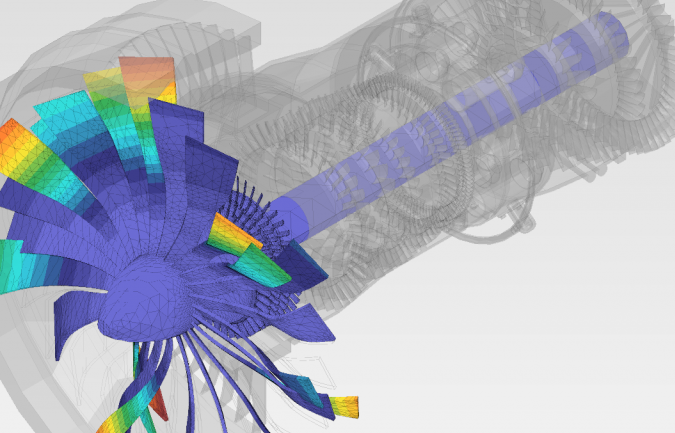
The run shown here is a 20-mode extraction on a 1.4-million-degree-of-freedom bladed disc, solved in 24 seconds. When a model outgrows the machine it runs on, it moves to the cloud without being rebuilt.
Knowledge base
Fifteen documents: the quick start, thirteen chapters of the manual and one work sample, with equations typeset from source.
Start with a model you already have.
Import the geometry, run one study, and read the result with the documentation open beside it.